 |
|
|
|
 |
|||
 |
|||
 |
 |
 |
 |
 |
|
||
 |
|
||
 |
|
||
 |
|
||
 |
|
||
 |
|
||
 |
|
||
 |
|
||
 |
|
||
 |
|
||
 |
|
||
|
|
|
|
|
|||
|
|||
|
|
|
|
|
|
||
|
|
||
|
|
||
|
|
||
|
|
||
|
|
||
|
|
||
|
|
||
|
|
||
|
|
||
|
|
||

by Monica Conrady
 ith only five days
to spend in a country as diverse as Sri Lanka, time is of the essence. We
had to decide what we really wanted to see and experience, then hit the road
running.
ith only five days
to spend in a country as diverse as Sri Lanka, time is of the essence. We
had to decide what we really wanted to see and experience, then hit the road
running.
We flew from Trivandrum in South Indiato Colombo, Sri Lanka’s capital,
where we were met by our pre-arranged driver and guide, the charming and knowledgeable
Mubarak. Once through airport formalities, we headed straight for Dambulla
and the Heritance Kandalama hotel. The stunning, award-winning, eco-friendly
Kandalama is an excellent jumping-off point for the ancient cities. Sadly,
we only had time to visit two.
…
named, it is said, for his secret lady love …
Sigiriya, a World Heritage Site, is a massive, flat-topped rock fortress
which rises sharply 260 feet above the plains. Legend has it that King Kassapa
created a palace and garden on the summit in the 5th century AD. A new theory
maintains that it was never a fortress or palace, but a Buddhist monastery
built long before King Kassapa’s time. There are steps that zigzag to
the top — approximately 2680 of them, up and down. And yes, we climbed
them!
Polonnaruwa, another World Heritage Site, was once a royal
capital, the remains of which tell of its former splendor. We wandered about,
soaking up the feeling of tranquility to be found among the ancient stones.
Our next stop was Kandy, the lively capital of the Hill Country, last Royal
Citadel, and home to Sri Lanka’s most important shrine, the Temple of
the Tooth Relic. Not only were we lucky enough to be there for poya (full
moon), when devout Buddhists visit the temple to make offerings and meditate,
but we also witnessed a special perahera (procession) in honor of a visiting
VIP. This involved dozens of colorful Kandyan dancers with drummers beating
drums and cracking whips before three lavishly caparisoned (decorative coverings)
elephants, one of which carried a replica of the sacred tooth relic cask.
From Kandy we made a side trip to the Pinnewala Elephant Orphanage, a government-run
retreat for abandoned, injured or orphaned elephants. Twice a day around 60
elephants, including many babies, are led down to the river to bathe. Visitors
may go in and give one a back scrub — a perfect photo op.
On to Nuwara Eliya (pronounced Nu-rel-iya), a former colonial hill station
situated in the heart of Sri Lanka’s famed tea country. What with its
country-style houses, the old Post Office, the Race Course, and the Hill Club
with its traditional bar, safari trophies and golf course, it’s Very
British indeed.
After a long drive to the south coast, which was heavily hit by the 2004
tsunami, our next ‘port-of-call’ was Galle (pronounced Gawl), with
its 17th century Dutch colonial fort, also a World Heritage Site. It’s
very atmospheric, with dramatic views of the town and the ocean from the ramparts
and intriguing little streets to explore. We stayed at the delightfully romantic
Galle Fort Hotel, a previously derelict 17th century Dutch merchant’s
house now transformed into a boutique hotel.
And finally, Mt. Lavinia, just south of Colombo, where we spent our last night at the Mount Lavinia Hotel, overlooking the Indian Ocean. Built in 1836 as a residence for the then British governor and named, it is said, for his secret lady love , it was the perfect romantic finale to our whirlwind glimpse of Sri Lanka.
Sri Lanka Tourist Board: www.srilankatourism.org.
Return to: Recent articles, Top, Home.
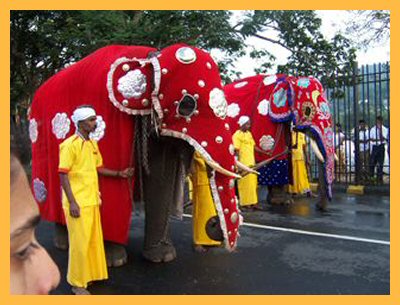
Elephants in Ceremonial Dress
Monica Conrady photo
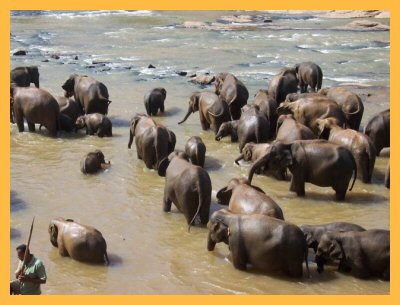 Elephant
Bath
Elephant
Bath
Monica Conrady photo