 |
|
|
|
 |
|||
 |
|||
 |
 |
 |
 |
 |
|
||
 |
|
||
 |
|
||
 |
|
||
 |
|
||
 |
|
||
 |
|
||
 |
|
||
 |
|
||
 |
|
||
 |
|
||
|
|
|
|
|
|||
|
|||
|
|
|
|
|
|
||
|
|
||
|
|
||
|
|
||
|
|
||
|
|
||
|
|
||
|
|
||
|
|
||
|
|
||
|
|
||

by Diane Brady
 y husband and I
had heard so much about the Paso Robles Inn that we decided to see what it
was like.
y husband and I
had heard so much about the Paso Robles Inn that we decided to see what it
was like.
This historic hotel, located in the town of Paso Robles, in California’s
Central Coast wine region, continues over a century of tradition by offering
the opportunity to “take the waters.” This began in 1891 with the
opening of the immense El Paso de Robles Hotel (“The Pass of the Oaks”).
It was three stories high, and an indication of its size is that it contained
a seven-acre garden.
It was built entirely of brick and masonry, and was considered fireproof!
Alas, in 1940 the fireproof hotel was completely destroyed by fire. Well,
not completely. A separate building, which housed the magnificent ballroom,
survived. In February 1942 the present inn opened.
The area was famous for its mineral water and mud baths, originally discovered
by the local Salinan indians (who called it “heaven’s spot”),
and many notable people came to “take the waters.” One of these
was the Polish pianist and statesman, Ignace Paderewski, whose career nearly
ended in 1913 due to arthritis in his hands. He stayed for three months, and
was able to resume his concert tour. (My husband recalled listening to Paderewski
recordings in his grammar school music appreciation classes at PS85 in the
Bronx.)
Paso Robles was a main stop on the railroad between San Francisco and Los
Angeles, so the hotel was a popular destination and attracted many people,
including celebrities, movie stars, and other notables.
In 1910, the San Francisco Seals baseball team in the Pacific Coast League
began using Paso Robles for spring training. They were soon joined by the
Chicago White Sox and Pittsburgh Pirates. I can imagine that the players found
the “waters” soothing to their aching muscles.
Paso Robles was (and still is) the gateway to William Randolph Hearst’s
mansion on the coast in San Simeon. From the mid ‘20s until the late
‘40s it saw a parade of movie stars, politicians, and business big-wigs
pass through.
The Hollywood glitterati included Lionel Barrymore, Lillian Gish, John Wayne,
Clark Gable, and Judy Garland, and such sports heavyweights as boxer Jack
Dempsy.
Grapes
were originally planted around 1797 by the friars at nearby Mission San Miguel.
In 1999, a local family named Martin bought the inn and began a multi-million
dollar upgrade to what had become a small hotel in a small town. As automobile
travel became more popular in the 1950s and passenger rail service began to
decline, Paso Robles declined also. Now, however, it is a popular destination,
due to its location in the wine country.
Grapes were originally planted around 1797 by the friars at nearby Mission
San Miguel. This was the beginning of the Central Coast Wine Region.
Tom Martin asked Floyd Butterfield, a local geologist, if he could come up
with a way to remove the noxious odor from the water. He did, so taking the
waters is now much more pleasant.
One truly notorious person who is reported to have spent time in Paso Robles
was the outlaw Jesse James. He supposedly was wounded in the chest during
a bank robbery (or by Union soldiers during the Civil War), and made his way,
with his brother Frank, to Paso Robles, where a law-abiding uncle, Drury James
lived, to recover from this poorly healing chest wound.
The hotel now has, in addition to standard rooms, over 30 suites with mineral
spas, some on a patio (with a privacy curtain), and is currently building
a larger spa facility.
Our room, a Garden Fireplace room, overlooked the gardens and had a gas fireplace,
which we greatly enjoyed, as the evening was cool.
Paso Robles Inn: tel. 800/676-1713; www.pasoroblesinn.com
Return to: Current articles, Top, Home.
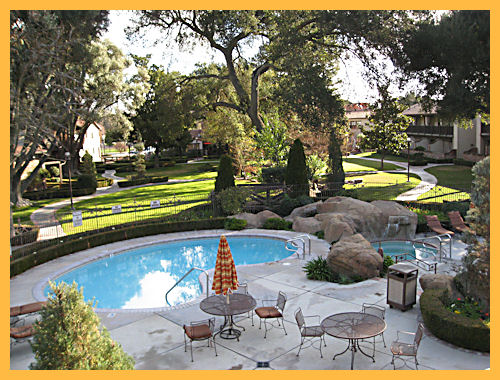
Paso
Robles Inn Gardens
Chuck Brady photo
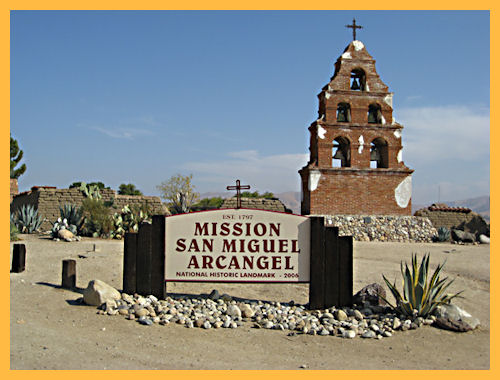 Mission
San Miguel
Mission
San Miguel
Chuck Brady photo