 |
|
|
|
 |
|||
 |
|||
 |
 |
 |
 |
 |
|
||
 |
|
||
 |
|
||
 |
|
||
 |
|
||
 |
|
||
 |
|
||
 |
|
||
 |
|
||
 |
|
||
 |
|
||
|
|
|
|
|
|||
|
|||
|
|
|
|
|
|
||
|
|
||
|
|
||
|
|
||
|
|
||
|
|
||
|
|
||
|
|
||
|
|
||
|
|
||
|
|
||

by Marian Jane Sanders
 y visit to the closely-guarded
opium fields near Mae Hong Son in northern Thailand (see last issue) left
me exhilarated, exhausted, and ready for the mundane comforts of a hot shower
and firm mattress.
y visit to the closely-guarded
opium fields near Mae Hong Son in northern Thailand (see last issue) left
me exhilarated, exhausted, and ready for the mundane comforts of a hot shower
and firm mattress.
The Bai-Yok Hotel offered both, though the hot water was only available until
10 pm. My room was spacious, with a queen-size bed and a high ceiling, and
the dark wood furnishings and white linens created an austere, calming effect.
The room faced a courtyard on one side and the street on the other, but was
blissfully quiet all night.
The
hill tribes have a distinctly different culture…away from the mainstream
of Thai life.
In the morning I walked a few blocks to a café with a thatched roof
and a sign over the door, “this best home-cooking anywhere.” The
menu featured international favorites: moussaka, pizza, enchiladas —
and a wide choice of vegetarian dishes. I ordered an omelette, and enjoyed
it to the accompaniment of a Beatles soundtrack.
Mae Hong Son, a small town nestled in the hills near the Thai-Burmese border,
is a crossroads for backpackers and trekkers, mostly from Western Europe and
the USA. Unlike Bangkok or even Chiang Mai, the ambiance here is relaxed.
It’s a perfect place to “hang out,” with nothing scheduled
beyond an occasional Thai massage. I was there for just two days, though,
and wanted to see more of the surrounding area.
So, for my second and last day, I signed up for a non-trekking tour to the
hill tribes of northern Thailand. The hill tribes have a distinctly different
culture from that of native Thais, and they keep to their isolated communities,
away from the mainstream of Thai life. Poverty is a characteristic of hill
tribe life, and the people of the tribes are often less healthy and less educated
than most Thais. Part of their income comes from tourist groups who visit
them.
Our first stop was to the Meo tribe, where we walked on our own past small
gardens with drying peppers and fenced-in pigs. Two old men sat on a hill
smoking a long pipe (opium?) while teen-age boys rode around town on motorcycles.
Later we watched 20 or so children and adults play a game in which they stood
in two long lines, dressed in colorful costumes, and threw a large ball back
and forth as they danced and laughed. This may have been a staged event, but
they seemed to enjoy it as much as we did.
Our next stop was to a Shan tribe, where we stopped just long enough for
lunch at the home of a young couple. Dressed in drab clothing, they brought
a simple meal of tea and rice to us from behind a curtain on their terrace.
They tried through gestures to make us feel welcome, but our “cultural
exchange” was very minimal.
Our final stop — and the highlight of the tour — was to the fascinating
and often-photographed Karen tribe. Karen women are known for the brass rings
on their necks. The rings are believed to enhance beauty, by stretching and
elongating the neck, and also show the wearer’s social position. The
first ring is placed on a girl’s neck when she’s about nine, and
gradually more rings are added. This custom is controversial, at least among
outsiders, but likely to continue since it’s a major tourist draw.
The Karen women are skilled in sewing, dyeing and weaving, and their wares
are inexpensive and beautiful. I bought a purse and jacket— lasting reminders
of my glimpse into another culture.
Return to: Recent articles, Top, Home.
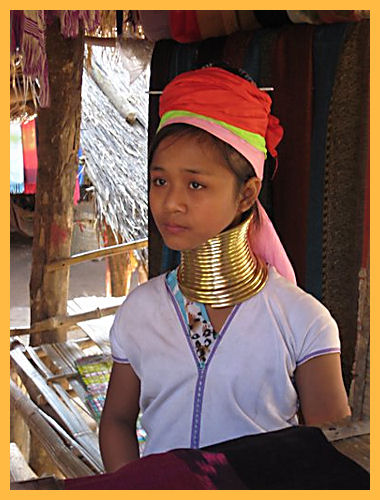
Karen
Girl