 |
|
|
|
 |
|||
 |
|||
 |
 |
 |
 |
 |
|
||
 |
|
||
 |
|
||
 |
|
||
 |
|
||
 |
|
||
 |
|
||
 |
|
||
 |
|
||
 |
|
||
 |
|
||
|
|
|
|
|
|||
|
|||
|
|
|
|
|
|
||
|
|
||
|
|
||
|
|
||
|
|
||
|
|
||
|
|
||
|
|
||
|
|
||
|
|
||
|
|
||

by Marian Jane Sanders
“Standing
on the corner in Winslow, Arizona, such a fine sight to see….”
— from Take it Easyby the Eagles
 he Eagles were singing
about a girl (of course), but in fact there’s no finer sight in Winslow
than La Posada, a sprawling hacienda-style inn where my partner and I stayed
recently.
he Eagles were singing
about a girl (of course), but in fact there’s no finer sight in Winslow
than La Posada, a sprawling hacienda-style inn where my partner and I stayed
recently.
After several long days touring the Grand Canyon, Monument Valley, and other
marvels of northeast Arizona, we arrived in Winslow — hot, tired, and
weary of forgettable restaurants and no-frills motels. For us, La Posada was
a veritable “oasis in the desert.”
Dubbed “the last great railroad hotel,” La Posada was built by
the Santa Fe Railroad in l930, and is a National Historic Landmark that is
part hotel, part museum. Mary Colter, perhaps the greatest architect of the
Southwest, designed the buildings, decorated the interiors, and planned the
gardens. Although Colter is best known for her magnificent buildings at the
Grand Canyon, La Posada was her favorite.
For us, La Posada was a veritable “oasis in the desert.”
In the hotel’s early days, it was a retreat for Hollywood stars and
other celebrities. Everybody stayed there, from Bob Hope to Amelia Earhart
to Albert Einstein. All passenger trains from Los Angeles to Chicago stopped
at La Posada; it was the finest small hotel on Route 66, and in the entire
Southwest.
But as train travel declined, and Route 66 was bypassed, the hotel fell into
disrepair. In 1957, La Posada was closed.
Then, in l997, Allan Affeldt and his wife, artist Tina Mion, purchased it
from the Santa Fe Railroad, and began a restoration project that continues
to this day. Their first commitment was to restore La Posada to its former
glory, and then to fill it with antiques and original art, much of it contributed
by Mion. As a result, the inn is as much museum as hotel.
The art is often intriguing, even fascinating, with nary an ordinary or dull
piece in sight. At one end of the lobby, imposing portraits of Presidents
Pierce and Polk look down sternly on guests. Elsewhere, the art is more whimsical.
A good example is Mion’s large mural, “New Year’s Party in
Purgatory for Suicides,” which depicts Virginia Woolf, Diane Arbus, and
others who have committed suicide, plus a few who have not, including Liberace
and his poodle. Liberace’s presence is explained in the mural’s
subtitle, “Liberace Makes a Guest Appearance Down from Heaven Just for
the Hell of It.”
A suspended spiral concrete and wrought-iron staircase, with glazed terra-cotta
stairs, leads to the guest quarters. We stayed in the moderately-priced Mary
Pickford Room, which was spacious and simply-furnished. Through a small window,
we had a lovely view of a cottonwood grove.
We spent little time in our room, though. After wandering through the galleries,
we relaxed on the terrace, next to a verdant garden of bush grass and other
native desert plants. Clay pots brimming with pansies, a small waterfall and
a tiled pond added to the picturesque scene.
Later we dined in the hotel’s beautifully restored Turquoise Restaurant,
which offers dishes from the original menus as well as contemporary Southwest
fare, such as elk medallions with cherry sauce.
One last stop, for a libation at the retro-themed Martini Bar, completed our
stay at La Posada — where history is everywhere, but the pleasures are
timeless.
La Posada: tel. 928/289-4366; www.laposada.org.
Return to: Recent articles, Top, Home.
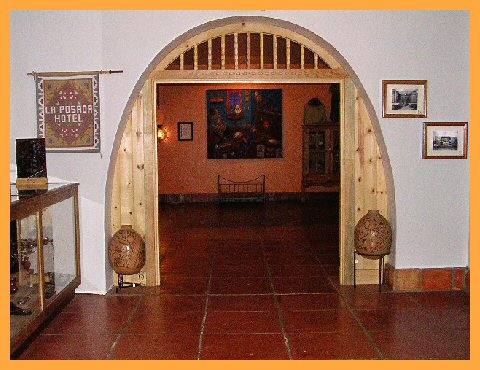 La
Posada Lobby
La
Posada Lobby
Marian Jane Sanders photo
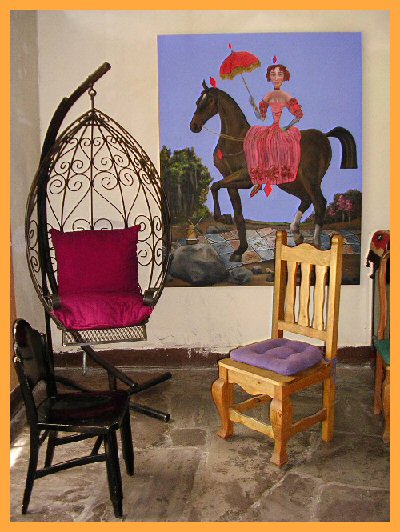 La
Posada Lobby
La
Posada Lobby
Marian Jane Sanders photo