 |
|
|
|
 |
|||
 |
|||
 |
 |
 |
 |
 |
|
||
 |
|
||
 |
|
||
 |
|
||
 |
|
||
 |
|
||
 |
|
||
 |
|
||
 |
|
||
 |
|
||
 |
|
||
|
|
|
|
|
|||
|
|||
|
|
|
|
|
|
||
|
|
||
|
|
||
|
|
||
|
|
||
|
|
||
|
|
||
|
|
||
|
|
||
|
|
||
|
|
||

by Monica Conrady
 f Ireland is the
Emerald isle, then Dominica is its Caribbean equivalent. Indeed, this verdant
island gives new meaning to the phrase, “the forty shades of green.”
f Ireland is the
Emerald isle, then Dominica is its Caribbean equivalent. Indeed, this verdant
island gives new meaning to the phrase, “the forty shades of green.”
Not to be confused with the Dominican Republic, Dominica — the largest
of the Windward chain — lies between the French islands of Martinique
and Guadeloupe. One of the most mountainous islands in the Caribbean, it is
a land of jagged volcanic peaks, deep valleys, dramatic waterfalls, cascading
rivers and streams so numerous they aren’t all named, and tropical foliage
so green it dazzles the eye.
Dominica is not a “sun, sand and sea” sort of place. Most of its
beaches are of the black-sand variety, there are no big resorts or duty-free
shops, and little nightlife to speak of. Its appeal is in its natural splendors,
small family-run hotels and inns, and an atmosphere reminiscent of the Caribbean
the way it used to be.
Dominica’s capital, Roseau, is a funky, somewhat ramshackle place. The
older buildings are wooden and have intricately carved balconies overhanging
the sidewalks. The old market, formerly a slave trading site, is now a crafts
market with a tourist information center. The “new” market is near
the river. Vera’s Guest House on Cork Street was the birthplace of Jean
Rhys, of Wide Sargasso Sea fame. The streets have London names — Hanover
Street, King George V Street, Drury lane — a reminder of Dominica’s
days as a British colony.
With just a few days to spare, we headed to the mountains and the Papillote
Wilderness Retreat. In this rainforest setting, surrounded by towering foliage-covered
peaks, we felt as if we had dropped into some tropical Garden of Eden.
…
an atmosphere reminiscent of the Caribbean the way it used to be.
Guest rooms are rustic, with simple, island-made furniture and spectacular
views. Natural hot mineral pools are a feature — two for hotel guests
and another for the use of day visitors. Papillote is famous for its gardens,
where footpaths and terraces lead to many delightful discoveries. Frequent
rain showers, so fine they’re called liquid sunshine, keep the air sweet
and the greenery vibrant. The food is Dominican style and excellent; the rum
punches are powerful.
A short walk away is Trafalgar Falls, one of Dominica’s main —
and more accessible — attractions. Tumbling 140 feet into fern-lined
pools below, half of the falls is icy cold, but the other half is a delicious
104 degrees. Chair-sized rocks make it nature’s perfect hot tub, but
due to a big landslide, we didn’t get to try it out.
The island has several spectacular dive sites, including one called “champagne,”
where divers swim through bubbling waters created by volcanic activity on
the sea bed. Excellent local dive operators arrange both diving and scuba
diving trips.
Only the most intrepid visitors endure the arduous, eight-hour hike to the
Valley of Desolation and Boiling Lake, led by knowledgeable local guides.
But there are many other delightful, and easier, walks for the rest of us.
The Carib Indian Territory, on the northeast coast, is home to the descendents
of the Caribbean’s fiercest tribe. Several small shops sell the popular
Carib baskets and straw mats, and it’s possible to stay overnight in
simple accommodations.
Dominica is not everybody’s cup of tea, but for adventurous souls and
those who seek a glimpse of the Caribbean’s wilder side, this is the
place.
Papillote Wilderness Retreat: www.papillote.dm.
Dominica Tourism: www.dominica.dm.
Return to: Current articles, Top, Home.
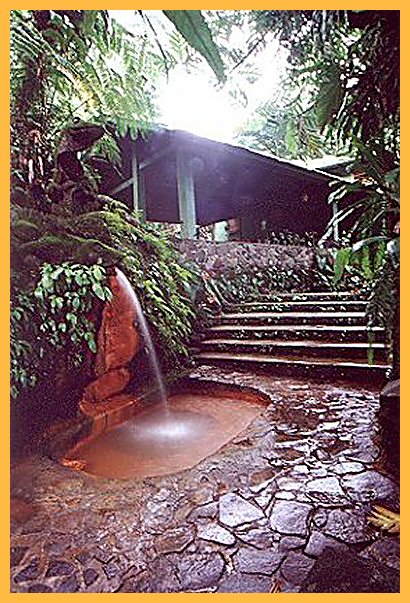 The
Hot Pool
The
Hot Pool
Papillote Wilderness Retreat photo