 |
|
|
|
 |
|||
 |
|||
 |
 |
 |
 |
 |
|
||
 |
|
||
 |
|
||
 |
|
||
 |
|
||
 |
|
||
 |
|
||
 |
|
||
 |
|
||
 |
|
||
 |
|
||
|
|
|
|
|
|||
|
|||
|
|
|
|
|
|
||
|
|
||
|
|
||
|
|
||
|
|
||
|
|
||
|
|
||
|
|
||
|
|
||
|
|
||
|
|
||

by Sheila O'Connor
 othing says “celebration”
like opening a nice bottle of champagne. Picture it now: the bubbly is chilled
and ready. The metal holder is unscrewed with excitement. You wait for that
familiar pop until—oops! The cork has not only gone airborne, it has
taken on a life of its own and sailed smack into your beautiful chandelier.
Not so much of a celebration now, is it?
othing says “celebration”
like opening a nice bottle of champagne. Picture it now: the bubbly is chilled
and ready. The metal holder is unscrewed with excitement. You wait for that
familiar pop until—oops! The cork has not only gone airborne, it has
taken on a life of its own and sailed smack into your beautiful chandelier.
Not so much of a celebration now, is it?
There must be a better way to get the cork out of that bottle. Well, now
there is, because Claude Mauffette, a designer and native of Montreal, (Montreal
is the city of design in Canada), has invented the Cork Catcher.
“I originally designed the Cork Catcher because a friend of mine was
opening a bottle of champagne and broke her nose when the cork came flying
off,” says Mauffette.
Not only is the Cork Catcher useful, it has won a host of design awards,
including the IDM (Institute of Design Montreal) Canadian Award in 2006 and
the 2007 IHA (International Houseware Association) award in Chicago. In addition
to designing the Cork Catcher, Mauffette has designed trophies for designers
themselves. The Cork Catcher however, is his pièce de résistance.
Mauffette designed various other corkscrews over a four-year period, but none
were as successful as the Cork Catcher.
Still, he had to go through a lot of these “less worthy” ideas
to get to the right one. “At first I tried a lever idea, but that didn’t
work. Then I thought of blades to grab the cork.”
If outcomes and science are your interest, then you’ll be interested
to know that, with the current invention, the cork flies off at 30 MPH and
the cylinder at the top acts as a brake. Polycarbonate and aluminum versions
are both available. The Cork Catcher has no moving parts.
For those of us without the scientific background, it’s enough to know
that it’s easy to use: all you do is press the device down while moving
the champagne or sparkling wine bottle a quarter turn. The cork comes out,
complete with the festive “pop,” but without the drama of flying
objects. Or the pain and tears afterward.
In 2004, Mauffette met with a representative from Screwpull, a German company,
to showcase his product. Screwpull had a patent that was about to expire and
they were more than interested in marketing the product. “Fantastic!
I want it!” was the instant reaction of the rep, and Mauffette’s
dream of a company with an outstanding reputation to sell his product was
the result. These days, Mauffette gets royalties from the sales.
Originally available only in Europe, where it has already sold over 150,000
units, the Cork Catcher now sells in North America too. It retails for around
US$20 for the plastic version and around double that for the aluminum one.
“The whole idea behind making it was to keep safety in mind,” says
Mauffette, as he demonstrates with ease how the Cork Catcher works.
Sounds like a good philosophy to have. Let’s raise our glasses and say “Cheers” to that.
Cork Catcher: www.screwpull.com.
Montreal Tourism office: www.tourisme-montreal.org.
Return to: Recent articles, Top, Home.
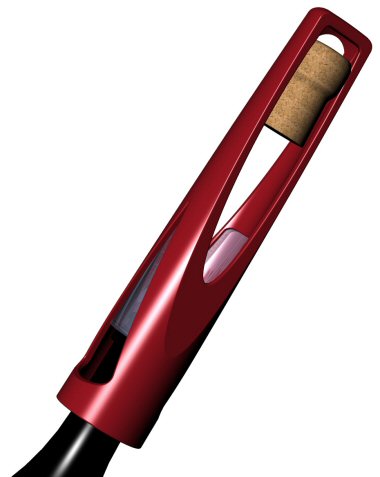
The Cork Catcher
Screwpull photo