 |
|
|
|
 |
|||
 |
|||
 |
 |
 |
 |
 |
|
||
 |
|
||
 |
|
||
 |
|
||
 |
|
||
 |
|
||
 |
|
||
 |
|
||
 |
|
||
 |
|
||
 |
|
||
|
|
|
|
|
|||
|
|||
|
|
|
|
|
|
||
|
|
||
|
|
||
|
|
||
|
|
||
|
|
||
|
|
||
|
|
||
|
|
||
|
|
||
|
|
||

by Monica Conrady
 lorida’s St.
Augustine, founded in 1565 and the nation’s oldest city, has long been
on my travel wish list. My wish was finally granted earlier this year when
my husband and I were pondering somewhere special to celebrate an anniversary.
St. Augustine sounded perfect.
lorida’s St.
Augustine, founded in 1565 and the nation’s oldest city, has long been
on my travel wish list. My wish was finally granted earlier this year when
my husband and I were pondering somewhere special to celebrate an anniversary.
St. Augustine sounded perfect.
We made our plans. We’d fly to Jacksonville, rent a car and drive the
50 miles down the coast to St. Augustine. Where to stay? We chose the Casa
Monica Hotel—how could I resist when it’s my namesake? Little did
we know it was the hotel of St. Augustine.
The
gleaming bathroom came with thick terry robes …
It was a bright, sunny Florida morning when we pulled into the carriage entrance
of the Casa Monica. The hotel’s exterior is “Spanish Moorish”
in style — its five towers, slender arched columns, wrought iron balconies
and splashing fountains, reminding us a little of a medieval castle. The elegant
lobby continues the theme, with mahogany columns, stenciled beams, Spanish
tiles, a bubbling fountain and glowing chandeliers.
The outdoor pool and hot tub area was a real treat, with striped, canopied
beds along one side to lounge on. I knew if I ever got on one of those, I’d
have a hard time getting up again!
Our suite (yes, we splurged) did not disappoint. The bedroom contained an
inviting Spanish-style, wrought iron bed dressed with luxury linens, a mahogany
armoire, writing desk and nightstands. The gleaming bathroom came with thick
terry robes and an array of tempting toiletries. The spacious lounge had all
the amenities we could wish for, including a bar and a formal dining area.
Alas, we knew no one to invite to dinner.
Once settled in, we set off to explore the area. St. Augustine is a town
just made for walking. We strolled around, enjoying the narrow, cobbled streets
lined with 18th century balconied houses, George Street with its many shops
and restaurants, and the attractive waterfront.
After a quick break for lunch, we hopped on one of the little sightseeing
trolleys that weave around the historic spots.
St. Augustine was founded September 7, 1565, by Spaniard Pedro Menendez de
Aviles and his expedition. It was they, not the Pilgrims, who arrived first
in the New World—a fact that many are unaware of.
The massive Castillo de San Marcos, circa 1672, was 23 years in the making.
It withstood numerous attacks and today stands as the cornerstone of the city’s
history. You can quite imagine the Spanish defenders holding off a British
attack using those huge cannons still in place.
When railroad magnate Henry Flagler arrived in 1885, he envisioned St. Augustine
as a winter getaway for wealthy northerners and so constructed two lavish
hotels, the Ponce de Leon and the Alcazar. Both are across the street from
the Casa Monica, the former now a college and the latter a museum.
We took a tour of Flagler College and were suitably impressed by the stately
rotunda and the dining hall with its Tiffany windows. We hoped the students
would not be distracted in such a setting.
Old St. Augustine Village was another charmer. A collection of historic homes
dating from 1790 to 1910 take up one city block. The oldest, the 1790 Prince
Murat House, is named after its most famous occupant, Prince Achille Murat,
a nephew of Napoleon Bonaparte.
That evening, we dined in the Casa Monica’s renowned restaurant, the
95 Cordova. It was wonderful.
There were still many sights to see—the Lightner Museum, the Oldest Wooden Schoolhouse, Ponce de Leon’s Fountain of Youth and so on. Tomorrow, tomorrow …!
Casa Monica Hotel: tel. 800/648-1888; www.casamonica.com. Visitors Information
Center: www.visitoldcity.com.
Return to: Recent articles, Top, Home.
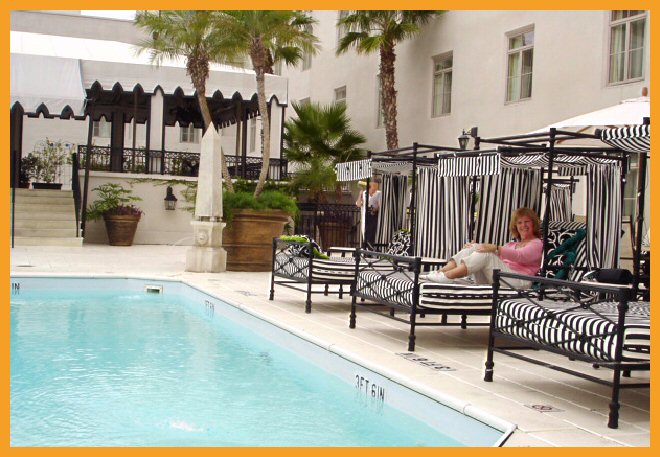 The
author relaxes poolside
The
author relaxes poolside
Ray Conrady photo