 |
|
|
|
 |
|||
 |
|||
 |
 |
 |
 |
 |
|
||
 |
|
||
 |
|
||
 |
|
||
 |
|
||
 |
|
||
 |
|
||
 |
|
||
 |
|
||
 |
|
||
 |
|
||
|
|
|
|
|
|||
|
|||
|
|
|
|
|
|
||
|
|
||
|
|
||
|
|
||
|
|
||
|
|
||
|
|
||
|
|
||
|
|
||
|
|
||
|
|
||

by Monica Conrady
 Mention you're going
to Bhutan and most likely you'll get a puzzled expression or a blank stare.
Friends have heard of it but can't quite place it. Not surprising really,
since this remote and hard-to-get-to country isn't exactly on the tourist
trail.
Mention you're going
to Bhutan and most likely you'll get a puzzled expression or a blank stare.
Friends have heard of it but can't quite place it. Not surprising really,
since this remote and hard-to-get-to country isn't exactly on the tourist
trail.
Sandwiched between the giants, India and China, the tiny Buddhist Kingdom of Bhutan is called Druk Yul by the locals-- in English, Land of the Thunder Dragon.
The
sense of being somewhere special starts the moment you fly into Paro …
It was only in the early 1960's that Bhutan first stepped into the 20th century.
Until then, there were no roads, and much of the country was accessible only
by horse or on foot. There was also no electricity, hospitals, schools, telephones
or postal service, and virtually no contact with the outside world. Things
have changed but, happily, at a slow and cautious pace.
The sense of being somewhere special starts the moment you fly in to Paro,
home to Bhutan's one and only airport and the only flat piece of land in the
entire country. You are surrounded by towering, snow-capped peaks, the air
is crystal clear and the Terminal is a traditional Bhutanese-style building.
Officials are dressed in their national costume-for men a <gho>, a belted,
knee-length robe worn with long socks and polished shoes; for women a <kira>,
a jacket and colorful, ankle-length, wrapped skirt. We felt as though we'd
landed in some magical, Himalayan-style Switzerland.
Our first hotel, the Gangtey Palace, overlooking the town of Paro, was a
gem. Over 100 years old, it was owned by the Royal Family until the 1930s,
and eventually converted into hotel. It was a great introduction to our Bhutanese
adventure.
There were six of us in our group, all from the San Francisco Bay Area. We
traveled by private minivan with a guide, a driver and a preplanned itinerary--Bhutan
permits no independent travel. Rabten, our driver, was a good and careful
driver-reassuring on those windy mountain roads. Dorji, our guide, was a charming
man, very knowledgeable, with a great sense of humor.
We were to spend the next 10 days together, making delightful discoveries.
In Thimpu. Bhutan's tiny capital, we visited the National Library, the Institute
for Zorig Chusam-the painting and woodcraft school, and the School of Traditional
Medicine. We stopped at the Post Office for stamps-which make excellent souvenirs.
Driving west, we climbed to the Dochu-la Pass which, at over 10,000 feet
was cloaked in cloud. Prayer flags fluttered in the mist. As we descended,
we spotted masses of wild rhododendrons in full bloom-a beautiful sight.
Most days we visited a dzong-the massive fortress-like monasteries built
in the 17th century -which today are half monastery and half administrative
center. If it weren't for the electricity, indoor plumbing and cell phones,
we could still be back in the 17th century. We see monks of all ages dressed
in flowing saffron or red robes going about their business. We get invited
to watch them pray and chant. The little ones can't resist peeping and smiling
at us when the head monk isn't looking.
We marvel at the houses and buildings, all decorated in traditional style
with intricate wood carvings and painted with animals, flowers and Buddhist
motifs.
I doubt there's a plain structure in the whole country.
One of the highlights of our trip was meeting Dorgi's family. We met them
for dinner-his wife and six-year old daughter, and his brother with wife and
baby. Dorji's little girl sang us songs she learned in school-in English.
Twinkle, Twinkle Little Star and Ten Green Bottles were her favorites.
The 10 days went by in a flash. It seems no time at all before we were back at Paro Airport, waving a sad farewell to Dorji. Bhutan had caught us in its spell.
Bhutan Tourism: www.kingdomofbhutan.com
Return to: Recent articles, Top, Home.
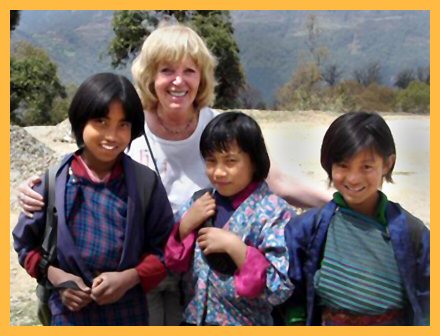
The author with charming local schoolgirls
Monica Conrady photo
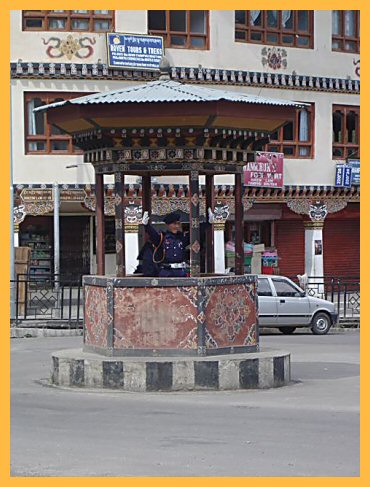 Bhutan's
only traffic signal!
Bhutan's
only traffic signal!
Monica Conrady photo